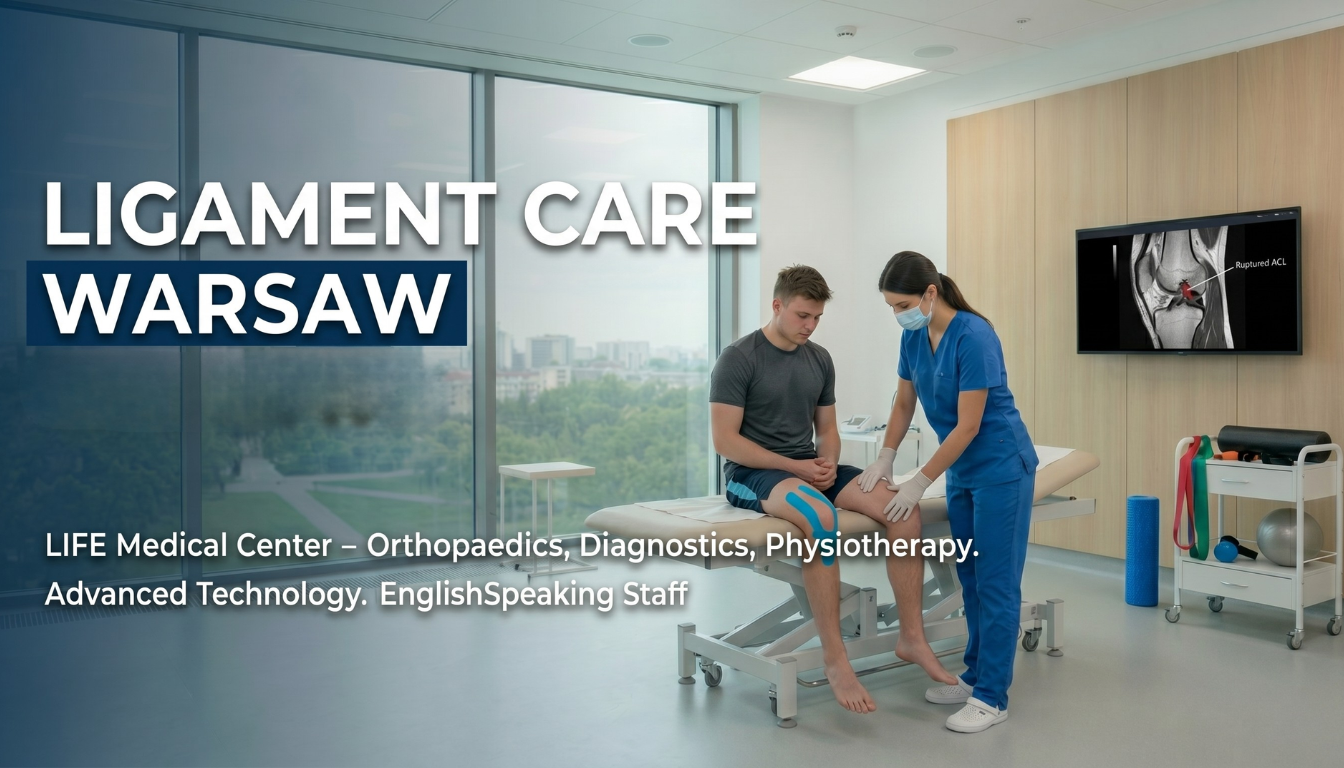
If you have a ligament injury in Warsaw, Life Medical Center provides English-speaking orthopaedic and physiotherapy care for expats with same-day and urgent appointments, evidence-based diagnostics (clinical exam, MRI, ultrasound) and treatments ranging from physiotherapy and injections (PRP/steroid) to surgery when indicated. We prioritise patient safety, informed consent and a structured rehabilitation plan to optimise recovery.
At LIFE Medical Center our English-speaking orthopaedic and physiotherapy teams assess and treat ligament injuries of the knee, ankle, shoulder and wrist using validated clinical tests and targeted imaging. Below is a selection of relevant services and typical prices for expats seeking private orthopaedic care in Warsaw.
| ORTHOPAEDICS & PHYSIOTHERAPY | ||
|---|---|---|
| Service | Type | Price |
| Orthopedic Consultation | Consultation | from 600 zł |
| Joint Ultrasound (1 joint) | USG | from 350 zł |
| PRP ARTHREX ACP™ (Platelet-Rich Plasma) — 1 injection | Treatment | from 1200 zł |
| PRP ESSENTIAL (Platelet-Rich Plasma) — 1 injection | Treatment | from 1050 zł |
| PRP ESSENTIAL — Consultation + Injection | Consultation | from 1400 zł |
| Physiotherapy & Manual Therapy — Full Session (PP/PS) | Treatment | from 230 zł |
*Prices are in accordance with the current LIFE Medical Center price list. Examinations are performed without a referral.
Why should I choose an English-speaking orthopaedic or sports injury clinic in Warsaw?
For expats a clinic that offers orthopaedic Warsaw English support reduces communication errors during the assessment of ligament injuries (e.g., ACL injury Warsaw or ankle ligament injury Warsaw). LIFE Medical Center provides English-speaking orthopaedic Warsaw services, physiotherapy ligament injury Warsaw programmes and same-day orthopaedic Warsaw appointments so that urgent symptoms—severe pain, instability, or inability to weight-bear—are assessed quickly.
How do you ensure patient safety and informed consent?
All procedures follow evidence-based protocols: a documented clinical consultation, clear explanation of risks and benefits, written informed consent for injections or surgery, and peri-procedural safety checks. We also maintain sterile technique for injections and ambulatory procedures and have clear escalation pathways for complications.
What is a ligament injury and what types are there?
Ligaments connect bone to bone and stabilise joints; they can be sprained (partial stretched) or torn. Clinically we describe sprain/tear by grade (I–III): Grade I is mild stretching, Grade II a partial tear with some instability, and Grade III a complete tear with marked instability.
Which ligaments are commonly injured in sports or accidents?
Common sports-related ligament injuries include ACL tears (knee ligament injury Warsaw), MCL and LCL injuries, PCL injuries in high-energy trauma, and ankle ligament injuries such as ATFL leading to chronic ankle instability Warsaw. Shoulder instability often involves the glenohumeral ligaments; wrist ligament injury Warsaw affects the scapholunate or TFCC in falls.
What symptoms should prompt me to seek urgent orthopaedic assessment?
Key symptoms are severe pain, rapid swelling (hemarthrosis in the knee), a feeling of joint giving way or true instability, and inability to weight-bear or use the limb. If you are an athlete with an acute pivoting injury and immediate swelling, contact same day orthopaedic Warsaw services for assessment.
What are red flags that need immediate attention?
Open wounds, neurovascular compromise (numbness, absent pulses), rapidly increasing swelling or signs of infection after an injection or procedure require urgent review. Also persistent mechanical instability after a few days may need early imaging and specialist input.
How are ligament injuries diagnosed in clinic?
Diagnosis combines a focused history, validated clinical tests and imaging. For ACL injury Warsaw we use the Lachman and pivot-shift; for ankle ligaments the anterior drawer test; for shoulder instability specific instability tests. Scores and functional tests support decision-making.
Do I need an MRI or ultrasound for a suspected ligament injury?
Ultrasound is useful for superficial ligaments (ankle, some wrist/shoulder structures) and guides injections (PRP ligament injection Warsaw). MRI is the reference standard for intra-articular structures like ACL or complex knee ligament or multi-ligament injuries; it informs surgical planning and prognosis.
What evidence-based treatment options exist for ligament injuries?
Treatment is tailored to the injured ligament, grade of injury, patient age, activity level and goals. Options range from conservative physiotherapy and bracing to injections (steroid for inflammatory conditions, PRP and other orthobiologics Warsaw for certain ligament or tendon indications) and surgery when instability or functional deficits persist.
When is conservative care appropriate and what does it include?
Many partial tears and low-grade sprains heal without surgery with a program of protected weight-bearing, bracing, progressive loading and structured physiotherapy focusing on neuromuscular control and strength. Physiotherapy packages at LIFE include manual therapy, exercise progression and return-to-sport criteria; tailored plans support rehabilitation after ligament injury Warsaw.
Are PRP or steroid injections offered for ligament injuries in Warsaw and when are they indicated?
Yes — LIFE offers PRP (e.g., PRP ARTHREX ACPTM and PRP ESSENTIAL) and steroid injections. PRP is considered for selected chronic partial ligament injuries or adjacent tendinopathy where tissue healing augmentation may help, whereas steroid injections are used for short-term symptom control in inflammatory conditions. Decisions follow evidence-based discussions about expected benefits and risks.
When is surgery indicated and what procedures are common?
Surgery is recommended for complete tears causing functional instability (e.g., ACL reconstruction for athletes or unstable knees), failed conservative care, or multi-ligament injuries. Procedures include ACL reconstruction, primary repair for select acute avulsions, ankle ligament repair/reconstruction and shoulder stabilisation for recurrent dislocation.
What does rehabilitation after ligament surgery or injury involve?
Rehabilitation is staged: early protection and range-of-motion, progressive strengthening and neuromuscular training, sport-specific loading, and objective return-to-sport testing. Timelines vary by ligament: many ankle sprains recover in weeks; ACL reconstruction rehabilitation commonly spans 6–9 months depending on graft and functional criteria.
How is return-to-sport decided?
Return is based on objective strength and functional tests, absence of instability, pain control and sport-specific readiness. We use validated criteria rather than fixed time alone to reduce re-injury risk.
Can ligament tears heal without surgery?
Partial tears and some low-demand patients can heal well with conservative care; complete tears in high-demand athletes more often require reconstruction to restore stability. Each case is assessed for the likelihood of healing, residual laxity, and patient goals before recommending surgery.
Can I get same-day orthopaedic assessment in Warsaw at LIFE?
LIFE Medical Center offers urgent and same-day orthopaedic appointments for acute sports injury clinic Warsaw needs. Contact reception to check availability; bring any imaging you already have and your insurance details if applicable.
How do I book and what should I bring?
Book by phone or online; bring ID, a list of medications, any prior imaging (photos, MRI/USG reports) and your insurance card. For expats, our English-speaking staff can assist with documentation and interpreter options if required.
How do I choose a private orthopaedic clinic in Warsaw as an expat?
Look for English-speaking orthopaedic Warsaw teams, transparent pricing, published rehabilitation services (physiotherapy ligament injury Warsaw), and clear protocols for urgent care. LIFE provides private orthopaedic Warsaw consultations, orthobiologics Warsaw options and physiotherapy packages to coordinate care under one roof.
What about costs and insurance for ligament treatment in Warsaw?
Costs vary by service; typical private consultation and intervention prices are listed above. LIFE accepts private payments and can process some international insurance claims—confirm coverage with your insurer before treatment. For specific package prices and insurance queries contact reception at +48 22 255 32 55.
What safety measures and infection control does LIFE Medical Center use?
We use sterile technique for injections and ambulatory procedures, standard peri-procedural checks, and documented consent. There are protocols for managing complications and post-procedure instructions to protect patient safety.
What is a typical patient journey and timeline?
-
- Acute ankle sprain (ATFL) — conservative route: Same-day orthopaedic or physiotherapy assessment, immobilisation/brace for 1–2 weeks if needed, early physiotherapy focusing on proprioception, return to sport 4–8 weeks depending on severity.
-
- ACL tear — reconstruction pathway: Early assessment and MRI to confirm diagnosis, prehabilitation physiotherapy for 4–8 weeks, ACL reconstruction if indicated, staged rehab with return-to-sport typically from 6–9 months guided by objective testing.
What are common diagnostic tests and functional assessments?
Clinical tests (Lachman, anterior drawer), ultrasound-guided assessments, MRI for intra-articular pathology, and functional scoring systems guide decision-making. Objective physiotherapy measures track progress during rehabilitation after ligament injury Warsaw.
FAQ
How long does a ligament injury take to heal?
Healing time depends on the ligament and injury grade: minor sprains (grade I) may improve in 2–6 weeks, partial tears (grade II) often need 6–12 weeks with rehabilitation, and complete tears (grade III) may require surgery and 6–9 months of rehab. Your orthopaedic and physiotherapy teams will provide a personalised timeline.
When do I need surgery for a ligament tear?
Surgery is considered for complete tears with functional instability, failure of conservative treatment, multi-ligament injuries or high functional demands (competitive athletes). The decision follows clinical examination, imaging, and a discussion of risks, benefits and expected outcomes.
Can ligament tears heal without surgery?
Many partial tears and lower-demand patients can recover with bracing, controlled loading and physiotherapy. Complete tears in active patients are less likely to regain stability without reconstruction, so individual assessment is required.
Do I need an MRI for a suspected ligament injury?
MRI is recommended when clinical tests suggest a major intra-articular ligament tear (e.g., ACL) or when symptoms persist despite conservative care; ultrasound is useful for superficial ligaments and for guiding injections. The orthopaedic assessment will determine appropriate imaging.
Is PRP or steroid injection offered for ligament injuries in Warsaw?
Yes; LIFE offers PRP injections and steroid injections where indicated. PRP may be considered for selected chronic ligament or tendon problems, while steroid is reserved for inflammatory pain; the orthopaedic team will explain evidence, indications and potential outcomes.
Can I get a same-day orthopaedic assessment in Warsaw?
Yes — LIFE provides urgent and same-day appointments for acute sports injuries. Call reception to check availability and bring any images and your identification to the visit.
How do I choose between private and public pathways and what about insurance?
Private care offers timely access to English-speaking orthopaedic Warsaw specialists, rapid imaging and coordinated physiotherapy; public pathways may have longer wait times. Check your international insurance for private clinic coverage or self-pay options; LIFE can provide detailed invoices for reimbursement.
Take care of your health today.
Book an apointment: +48 22 255 32 55 | Location: ul. Grzybowska 43a/U10, Warszawa.