Achilles Tendon Ruptures — English-Speaking Orthopaedic & Physiotherapy Care in Warsaw
An Achilles tendon rupture is a full tear causing sudden heel pain, swelling and difficulty pushing off; it requires prompt diagnosis with ultrasound or MRI. In Warsaw, expats can receive evidence-based, English-speaking care—ranging from supervised conservative treatment to surgical repair—followed by guided physiotherapy to maximize recovery and safety.
| Orthopaedics, Diagnostics & Physiotherapy | ||
|---|---|---|
| Service | Type | Price |
| Joint Ultrasound – 1 joint / body area | Examination | from 350 zł |
| Ultrasound – 1 body area | Examination | from 300 zł |
| Orthopedic Consultation + Ultrasound | Package | from 450 zł |
| Manual Therapy – 50 min. | Treatment | from 220 zł |
*Prices are in accordance with the current LIFE Medical Center price list for 2026. Examinations are performed without the need for a medical referral.
What is an Achilles tendon rupture and how is the tendon structured?
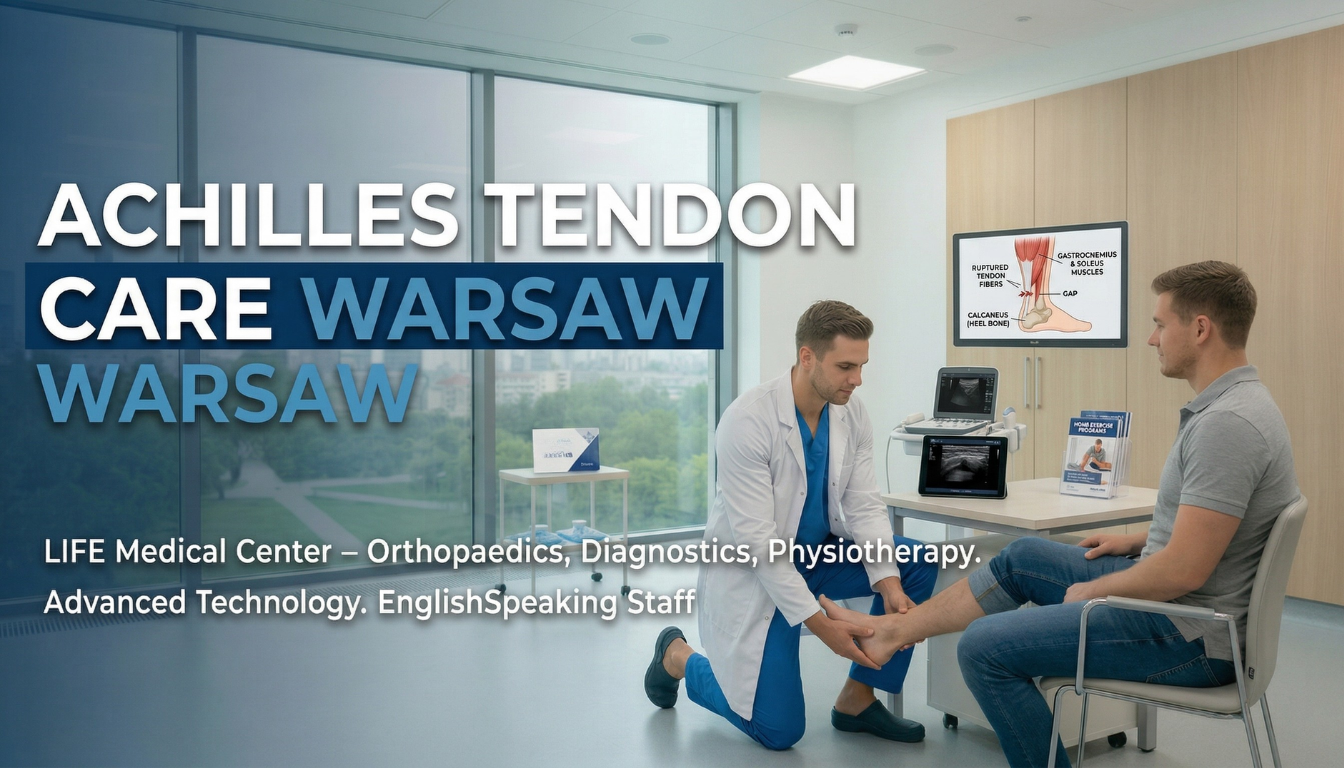
The Achilles tendon connects the calf muscles (gastrocnemius and soleus) to the calcaneus (heel bone) and transmits the force required for walking, running and jumping. A rupture means a full-thickness tear of the tendon fibres—often 2–6 cm proximal to the calcaneal insertion—leading to sudden pain, loss of plantarflexion power and difficulty pushing off during gait. Understanding the anatomy helps guide diagnosis (clinical tests, ultrasound or MRI) and the choice between conservative care and surgery.
Who is at risk and what commonly causes an Achilles tendon rupture?
-
- Age and activity: Middle-aged men (30–60 years) who participate in intermittent sports are a common group; degenerative changes and tendinopathy increase risk.
-
- Intrinsic factors: Chronic Achilles tendinopathy, reduced tendon vascularity, systemic medications (fluoroquinolones, corticosteroids), and metabolic conditions (diabetes, hypercholesterolaemia) raise susceptibility.
-
- Acute triggers: Sudden eccentric loading—such as pushing off to sprint or a fast change of direction—can precipitate rupture.
What are the typical symptoms and when should I seek urgent care?
Patients usually report a sudden, sharp “pop” or sting at the back of the ankle, immediate swelling and difficulty standing on tip-toe. Signs include a palpable gap in the tendon, bruising and positive Thompson test (absence of plantarflexion when the calf is squeezed). Seek urgent assessment if you experience sudden heel pain with loss of push-off, as prompt diagnosis with ultrasound or MRI influences treatment choice and outcomes.
How do we diagnose an Achilles rupture — what is the role of clinical tests, ultrasound and MRI?
Clinical examination (Thompson test, palpation of a gap, weakness on resisted plantarflexion) is the first step. Ultrasound diagnosis Achilles tendon injuries is fast, bedside-accessible and excellent for identifying full-thickness tears and tendon retraction; it also helps plan percutaneous procedures. MRI Achilles tendon imaging provides detailed evaluation of tendon ends, surrounding structures and chronic degeneration—useful when surgery planning or when ultrasound is inconclusive. At LIFE Medical Center we combine clinical assessment with targeted ultrasound and use MRI selectively.
What treatment options are evidence-based for Achilles tendon ruptures?
Treatment choices include supervised conservative management (functional bracing with early protected weight-bearing) and surgical repair. Evidence supports both approaches for many patients when early functional rehabilitation is used; surgical repair can reduce re-rupture rates in some populations but carries surgical risks. Decisions are individualised based on patient age, activity demands, gap size, comorbidities and patient preference, using shared decision-making and English-speaking orthopaedic consultations in Warsaw.
When can an Achilles tendon rupture be treated without surgery?
Non-surgical management is appropriate for many patients, especially those with lower functional demands or with small tendon gap and good apposition on imaging. A functional rehabilitation protocol—early range-of-motion and progressive weight-bearing in a boot—has similar long-term outcomes to surgery in selected groups while avoiding operative risks.
What immobilisation and conservative protocols do you use?
Conservative protocols at our clinic typically start with a boot or cast in plantarflexion transitioning over 6–8 weeks to neutral and then to an ankle brace as weight-bearing increases. Supervised physiotherapy focuses on early controlled loading, range of motion and progressive strengthening to restore tendon capacity and reduce stiffness.
Are injections or regenerative treatments like PRP effective for Achilles problems?
For Achilles tendinopathy (chronic degeneration) PRP injections have mixed evidence; some studies show symptomatic improvement while others show limited or transient benefit. For acute full-thickness ruptures, PRP is not a standard primary treatment—surgical repair or structured conservative rehabilitation remain the mainstays. We discuss realistic expectations and current evidence when considering adjuvant therapies.
What surgical procedures are available and how do they differ?
Surgical options include open repair (direct suture of tendon ends) and minimally invasive or percutaneous repair techniques. The choice depends on tendon quality, gap size, skin condition and surgeon assessment.
What is open repair — what are benefits and risks?
Open repair provides direct visualisation of the tendon ends and allows robust suture techniques, often used for large gaps or poor tendon tissue. Benefits include strong initial repair strength and the ability to address associated pathology; risks include wound complications, infection and sural nerve injury.
What is percutaneous or minimally invasive repair — what are benefits and risks?
Percutaneous repair uses small incisions and suture passage under imaging or palpation; it reduces soft tissue trauma and may lower wound complication rates. However, it requires experience to avoid sural nerve injury and may be less suitable for severely retracted or degenerative tendons.
How do you ensure anaesthesia safety, infection control and perioperative care?
We use standard perioperative protocols: pre-op medical assessment, targeted anaesthesia (regional block or general where appropriate), prophylactic antibiotics when indicated, and strict sterile technique. Post-op care includes thromboprophylaxis assessment, pain control and early mobilisation planning with physiotherapy to prioritise patient safety.
How do outcomes, complications and recovery timelines compare?
Typical recovery after repair involves 8–12 weeks to basic activities of daily living and 4–6 months to return to higher-level activity; return to competitive sport may take 6–12 months depending on rehab progression. Surgical repair may have lower re-rupture rates but higher short-term complications; functional rehab after non-operative care yields similar long-term functional outcomes for many patients when protocols include early protected weight-bearing.
What other related conditions should be considered?
What is the difference between retrocalcaneal bursitis, Achilles tendinopathy, and Haglund’s deformity?
Retrocalcaneal bursitis is inflammation of the bursa between the tendon and calcaneus; Achilles tendinopathy is chronic tendon degeneration with pain and thickening; Haglund’s deformity is a bony prominence at the posterior calcaneus that can irritate the tendon and bursa. Accurate diagnosis with ultrasound or MRI guides targeted treatment—conservative care, injection therapy, or surgical correction if necessary.
What does physiotherapy and rehabilitation look like after a rupture?
Rehabilitation is phased and evidence-based, focusing on early protection then progressive loading to restore tendon capacity. Close collaboration between orthopaedic surgeons and physiotherapists—available in English at our clinic—optimises recovery and reduces the risk of reinjury.
What happens during early protection, weight-bearing progression and immobilisation?
Initial phase (0–2 weeks) emphasises protection in a boot with plantarflexion; early weight-bearing is often introduced in a controlled manner. Over weeks 3–8 the heel position is gradually reduced, weight-bearing is increased and gentle range-of-motion exercises start under physiotherapist supervision.
When does strengthening, proprioception and functional retraining start?
From about 6–8 weeks onward, progressive strengthening (eccentric and concentric calf loading), balance and proprioception exercises are introduced. Return-to-running and sport are progressed only when strength, symmetry and specific functional milestones are met.
What criteria determine return to work, running and sport?
Return-to-activity decisions are based on objective strength (usually >80–90% of the uninjured side), pain-free function, endurance and sport-specific tests. Clinical assessment and shared decision-making ensure safe timelines tailored to the patient’s job or athletic goals.
Can I get English-speaking orthopaedic and physiotherapy care in Warsaw?
Yes. LIFE Medical Center provides English-speaking consultations with orthopaedic specialists and physiotherapists, supporting expat healthcare needs in Warsaw. We prioritise clear communication, informed consent and evidence-based options so international patients can make safe, well-informed decisions.
Najczęściej zadawane pytania (FAQ)
What are the common symptoms of an Achilles tendon rupture?
Common symptoms include a sudden sharp pain at the back of the ankle, swelling, bruising and difficulty pushing off or standing on tip-toe. Patients often report a popping sensation at the time of injury.
Can an Achilles tendon rupture be treated without surgery?
Yes, selected patients can be treated non-surgically using functional bracing and a progressive rehabilitation protocol. Outcomes can be similar to surgery for many patients when early protected weight-bearing and physiotherapy are followed.
How is an Achilles rupture diagnosed — ultrasound or MRI?
Ultrasound is a fast, accurate first-line test to confirm a full-thickness tear and assess tendon gap; MRI gives detailed assessment of tendon quality and surrounding structures when needed for surgical planning. Clinical tests remain an essential part of diagnosis.
What surgical options exist and how do they differ (open vs percutaneous)?
Open repair allows direct visualisation and robust suturing of tendon ends, while percutaneous repair uses smaller incisions and may reduce wound complications. The choice depends on tendon condition, gap size and surgeon assessment.
What are the risks and recovery times after Achilles tendon surgery?
Risks include wound complications, infection and nerve irritation; recovery typically involves protected weight-bearing, progressive physiotherapy and return to sport over 4–12 months depending on the individual. Thrombosis risk and pain control are assessed perioperatively.
Will private treatment at LIFE Medical Center accept international insurance or self-pay?
We accept self-pay patients and can provide detailed invoices and documentation to help you claim reimbursement from international insurers. Please contact reception to confirm whether your specific insurance plan is supported before your visit.
Zadbaj o swoje zdrowie już dziś
Umów się na badanie: +48 22 255 32 55 | Lokalizacja: ul. Grzybowska 43a/U10, Warszawa.