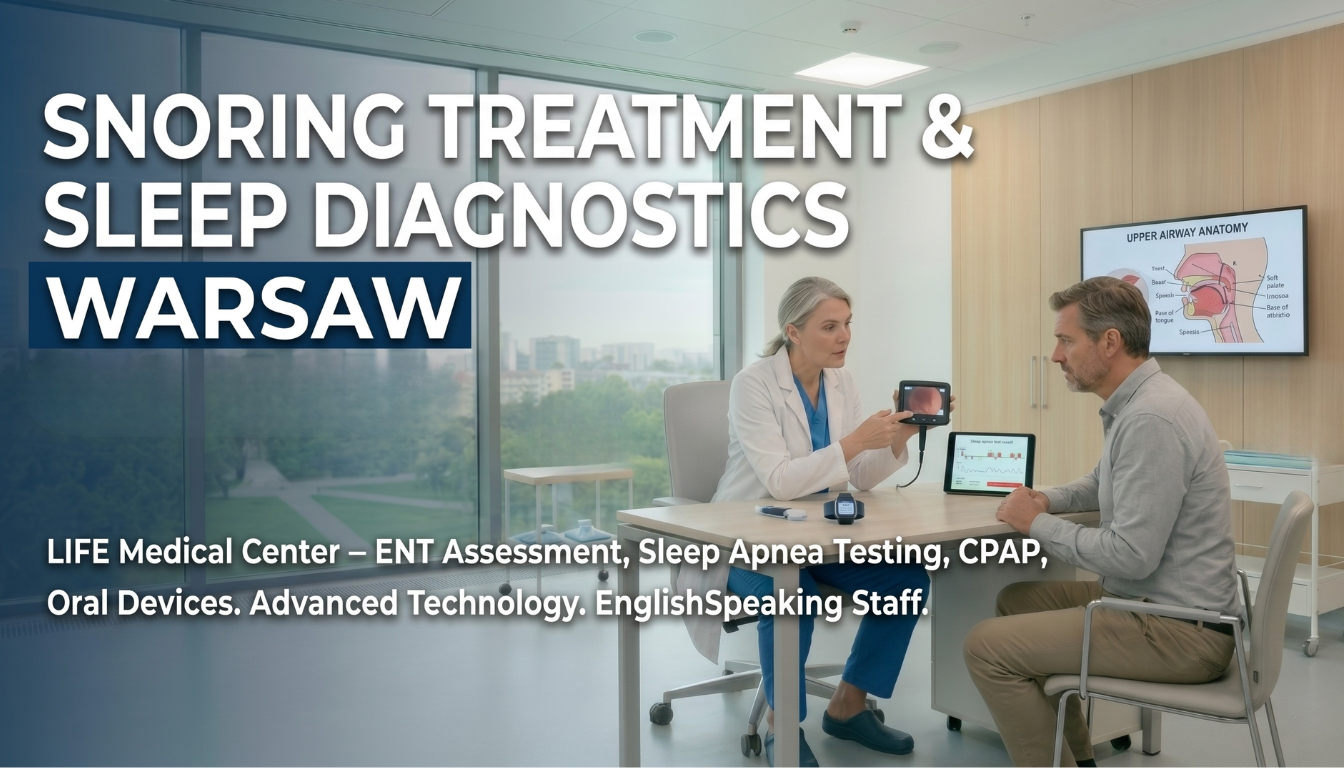
Snoring Treatment for Expats — Safe, Evidence-Based Diagnosis & Care
Snoring is caused by vibration of tissues in the upper airway and can range from benign to a sign of obstructive sleep apnea; treatment depends on the cause and severity. Evidence-based options include lifestyle changes, positional therapy and oral devices, CPAP for OSA, or targeted ENT procedures — see a doctor if snoring is loud, accompanied by choking/gasping, or daytime sleepiness.
| Snoring & Sleep Diagnostics | ||
|---|---|---|
| Service | Type | Price |
| Otolaryngology consultation | Consultation | from 350 zł |
|
Consultation + Fiberscopy (Endoscopic examination of the upper respiratory tract) |
Package | from 420 zł |
| Sleep Apnea Diagnostics Consultation | Examination | from 660 zł |
|
Coblation Snoring & Sleep Apnea Treatment (CELON – Prosleep) – Soft Palate |
Treatment | from 3700 zł |
*Prices are in accordance with the current LIFE Medical Center price list. Examinations are performed without the need for a referral.
Why is this guide useful for expats in Warsaw?
As an expat you may face language or insurance barriers when seeking care for snoring and possible obstructive sleep apnea (OSA). This guide explains clear, evidence-based diagnostic steps and treatments available at LIFE Medical Center — including ENT assessment, sleep study options, CPAP and oral devices — to help you choose safe care and keep continuity with international medical records.
What is snoring and how does it happen?
Snoring is the sound produced when soft tissues in the upper airway vibrate during sleep. Anatomy such as the soft palate, uvula, tonsils, nasal passages and base of tongue can contribute; nasal obstruction, excess tissue in the throat, or reduced muscle tone from alcohol or medications increase vibration and snoring risk.
Which anatomical structures cause the vibration that leads to snoring?
Vibration typically arises from the soft palate and uvula, nasal valve collapse, or redundant tissue at the base of tongue. A targeted ENT exam with nasal endoscopy or fiberscopy helps localise the source and guide treatment decisions.
What common causes and risk factors increase snoring?
-
- Nasal obstruction (deviated septum, allergic rhinitis)
-
- Soft palate vibration or elongated uvula
-
- Enlarged tonsils or pharyngeal tissue
-
- Obesity and increased neck circumference
-
- Alcohol, sedative medications, smoking, and age-related muscle tone loss
-
- Family history and specific throat anatomy
When should I worry and see a doctor about snoring?
See a clinician if snoring is loud, distressing to a partner, associated with witnessed pauses in breathing, gasping or choking, or if you have excessive daytime sleepiness. These are potential signs of obstructive sleep apnea, which increases cardiovascular risk and requires timely assessment.
How do travel and language affect expat care for snoring?
Frequent travel, night-shift work and jet lag may worsen snoring and OSA symptoms. LIFE Medical Center can assist with interpreter services, transfer of medical records and advice on portable therapies to maintain continuity of care across borders.
How is snoring diagnosed in a safe, evidence-based pathway?
Diagnosis starts with a focused medical history and physical exam, screening for OSA (e.g., STOP-Bang), followed by ENT assessment and, when indicated, a sleep study. This staged approach prioritises patient safety and targets therapy to the identified cause.
What happens during the primary evaluation and STOP-Bang screening for OSA?
A clinician documents symptoms (snoring, witnessed apnoeas, daytime sleepiness), comorbidities and sleep hygiene, then uses STOP-Bang or similar validated tools to estimate OSA risk. High-risk patients are referred for objective testing such as a home sleep apnea test or in-lab polysomnography.
What does an ENT assessment include for snoring diagnosis?
An ENT specialist performs an ear–nose–throat exam, nasal endoscopy or fiberscopy to inspect the nasal passages, septum, turbinates, tonsils, soft palate and tongue base. Findings guide whether nasal therapy, oral device, minimally invasive procedure or surgery is appropriate.
What are the differences between home sleep apnea testing and in-lab polysomnography?
Home sleep apnea testing (HSAT) records respiratory parameters and is validated for moderate-to-severe OSA screening in patients without complex comorbidities. In-lab polysomnography (PSG) is more comprehensive — monitoring EEG, arousals and other sleep stages — and is recommended when diagnosis is uncertain or other sleep disorders are suspected.
What snoring treatments are offered from least to most invasive?
Treatment is selected based on cause and severity: start with lifestyle and positional changes, progress to devices (nasal dilators, mandibular advancement devices), use CPAP for OSA, and consider ENT procedures (radiofrequency, koblacja) or surgery when indicated.
What lifestyle and positional measures reduce snoring?
Weight loss, avoiding alcohol and heavy meals 3–4 hours before bed, smoking cessation, and improving nasal allergies can reduce snoring. Positional therapy (sleeping on the side, positional pillows) helps when snoring is position-dependent.
Are nasal strips, nasal dilators and mouth guards effective and safe?
Nasal strips and internal nasal dilators can improve airflow and may reduce snoring caused by nasal obstruction. Mandibular advancement devices (oral appliances) are effective for snoring and mild-to-moderate OSA in selected patients; they must be fitted by trained clinicians and monitored for dental or jaw side effects.
When is CPAP recommended and how can patients improve adherence?
Continuous positive airway pressure (CPAP) is the gold-standard therapy for moderate-to-severe OSA and prevents airway collapse during sleep. Adherence improves with mask fitting, pressure titration, patient education, and early follow-up to troubleshoot discomfort and side effects.
What evidence supports minimally invasive ENT procedures such as radiofrequency or laser (koblacja)?
Minimally invasive techniques (radiofrequency ablation, laser-assisted palatoplasty, koblacja) reduce tissue bulk or stiffen the soft palate and can reduce snoring severity. Clinical trials show modest to good symptom improvement for carefully selected patients; success depends on accurate localisation by ENT assessment and realistic expectations about results and possible need for repeat treatments.
Who might be a candidate for surgical options like septoplasty, tonsillectomy or uvulopalatopharyngoplasty?
Surgical interventions are considered when there is a clear anatomic contributor amenable to correction: septoplasty for septal deviation, tonsillectomy for hypertrophic tonsils, or uvulopalatopharyngoplasty when soft palate collapse is primary. Decisions are individualized based on ENT findings, sleep study results, and patient preferences, prioritising safety and functional outcomes.
Can snoring be cured permanently and what is the recurrence risk?
Some causes (corrected nasal obstruction or tonsillectomy) can produce long-lasting improvement, but recurrence is possible with weight gain, ageing or changes in sleep physiology. Many treatments reduce snoring but do not guarantee a permanent cure; ongoing risk-factor management improves long-term outcomes.
How can expats access private snoring treatment at LIFE Medical Center?
Expats can book by phone or email, bring any previous medical records, and request interpreter support if needed. LIFE Medical Center provides private billing and can prepare a treatment plan compatible with international insurers or for self-pay patients.
How do I book, what should I bring and are interpreters available?
Call +48 22 255 32 55 to book an appointment. Bring ID, list of current medications, and any prior sleep study or ENT reports to speed assessment. Interpreter services can be arranged on request to ensure clear informed consent and continuity of care.
What should I know about insurance, private billing and treatment planning?
Bring your international insurance details; we can provide invoices and reports suitable for reimbursement. A clear written plan after initial evaluation outlines recommended diagnostics (ENT exam, HSAT or PSG) and an evidence-based sequence of treatment options with estimated costs.
What home remedies and self-help measures are evidence-based?
Efficacious self-help measures address modifiable risk factors: weight reduction, avoiding late alcohol, treating nasal congestion (saline, intranasal steroids for allergic rhinitis) and positional therapy for positional snoring. Exercises to strengthen oropharyngeal muscles (throat exercises) have modest benefit in selected patients.
When do throat exercises, nasal care and sleep hygiene help?
Throat exercises (oropharyngeal training) can reduce snoring intensity in some studies, particularly for mild snoring due to reduced muscle tone. Nasal saline and appropriate allergy treatment improve nasal flow; consistent sleep times and avoiding sedatives support overall sleep quality.
Is snoring different in children and when is urgent care needed?
In children, snoring often signals enlarged tonsils/adenoids and can affect behaviour, growth and school performance. Urgent ENT evaluation is warranted for pauses in breathing, excessive daytime sleepiness, failure to thrive, or behavioural changes that may indicate paediatric OSA.
FAQ
What causes snoring and how is it diagnosed?
Snoring results from vibration of upper airway tissues (nose, soft palate, tongue base). Diagnosis starts with history and ENT exam; if OSA is suspected, a STOP-Bang screening and sleep test (HSAT or in-lab PSG) are used to confirm the diagnosis.
Can snoring be cured permanently?
Some causes can be corrected (e.g., surgery for septal deviation or tonsillectomy) and produce long-lasting improvement, but recurrence is possible with weight gain or ageing. Many patients achieve meaningful, durable symptom reduction with a combination of treatments and risk-factor management.
Is snoring always a sign of sleep apnea?
No — many people snore without OSA, but loud snoring with witnessed apnoeas, gasping or daytime sleepiness suggests OSA and requires objective testing. Screening tools and sleep studies distinguish simple snoring from obstructive sleep apnea.
How long does a sleep study take and is a referral needed?
Home sleep apnea tests typically record one night at home and are arranged after initial clinical assessment; in-lab polysomnography usually lasts one night in the sleep lab. For most private visits at LIFE Medical Center you do not need a GP referral, but bring prior records if available.
Are CPAP and oral appliances effective for snoring?
CPAP is highly effective for OSA-related snoring when used correctly; adherence is crucial. Mandibular advancement devices are effective for snoring and mild-to-moderate OSA in selected patients and require dental evaluation and follow-up for safety.
How much does a typical ENT consultation or diagnostic visit cost?
At LIFE Medical Center a standard ENT consultation costs approximately 350 zł and a sleep diagnostics consultation (diagnostyka bezdechu sennego) is listed at 660 zł in the current price list. Combined packages including fiberscopy are also available — check the clinic list for current options.
Take care of your health today
Book your appointment: +48 22 255 32 55 Location: Grzybowska 43a/U10, Warsaw