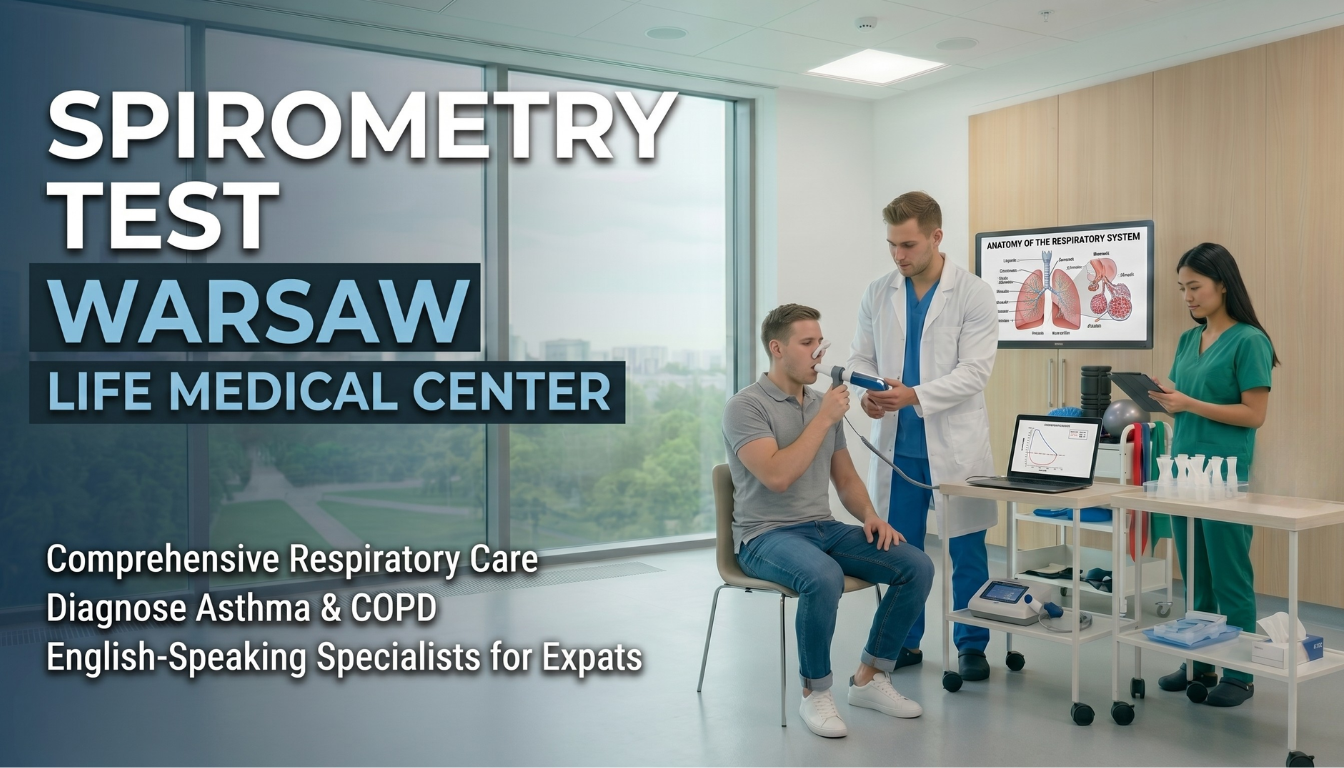
A spirometry test is a quick, non-invasive breathing test that measures how much air you can exhale and how fast (key measures: FEV1 and FVC). It involves breathing into a mouthpiece connected to a spirometer and usually takes 10–30 minutes including coaching and any pre/post-bronchodilator measurements. Results are compared to predicted normal values to help diagnose and monitor conditions like asthma and COPD.
| PULMONOLOGY / CONSULTATIONS | ||
|---|---|---|
| Service | Type | Price |
| Pulmonology Consultation + Spirometry | Examination | from 420 zł |
| Pulmonology Consultation | Consultation | from 300 zł |
*Prices are in accordance with the current LIFE Medical Center price list. Examinations are performed without the need for a referral.
What is a spirometry test and who should consider it?
Spirometry is a pulmonary function test — a breathing test that objectively measures lung function, specifically forced expiratory volume in one second (FEV1) and forced vital capacity (FVC). Patients with symptoms such as persistent cough, wheeze, unexplained shortness of breath, or risk factors (long-term smoking, occupational exposures) should consider spirometry to help diagnose conditions like asthma, chronic obstructive pulmonary disease (COPD) and to monitor response to therapy. In private spirometry Warsaw clinics like LIFE Medical Center, testing is performed by trained personnel with quality control and safety protocols.
What does spirometry measure — what are FEV1, FVC and FEV1/FVC?
Spirometry records how much air you can exhale (FVC) and how much of that air you can force out in the first second (FEV1). The FEV1/FVC ratio helps distinguish obstructive from restrictive patterns: a reduced ratio suggests obstruction (e.g., COPD, asthma), while a normal or high ratio with low lung volumes suggests restriction. Results are reported as absolute values and percent predicted for age, sex, height and ethnicity, allowing clinicians to interpret results against expected normal ranges.
How is a spirometry test done — what happens step-by-step?
What pre-test checks and patient instructions are performed?
Before testing a clinician or lung function technician reviews your medical history and current medications and checks for contraindications (recent eye/abdominal surgery, chest pain, recent respiratory infection). Baseline vital signs and a brief physical assessment ensure it is safe to proceed. Patients are asked about smoking, inhaler use, and any recent illness.
How is the test performed — what technique and coaching are used?
During the breathing test, you sit upright and wear a nose clip. A technician instructs you to inhale fully, seal your lips around a mouthpiece connected to the spirometer, and exhale forcefully and quickly until told to stop. Coached repetitions (usually 3 acceptable efforts) are recorded to achieve reproducible FEV1 and FVC values; coaching improves test quality and safety.
What is a post-bronchodilator test and when is it used?
A post-bronchodilator test measures spirometry after administering an inhaled bronchodilator and waiting (typically 10–15 minutes). It helps determine reversibility of airflow obstruction — a significant improvement in FEV1 after bronchodilator supports asthma or bronchodilator-responsive disease, while persistent obstruction suggests fixed airflow limitation as in COPD.
How should I prepare for spirometry — which medications, food or habits matter?
Do I need to stop medications, food, smoking or change clothing before spirometry?
Follow your clinic’s guidance about withholding bronchodilators; commonly short-acting bronchodilators are held for 6–8 hours and long-acting agents for longer (your prescribing clinician will advise). Avoid heavy meals and smoking for at least one hour before the test and wear loose clothing to allow full chest and abdominal movement. Bring your inhalers and a list of medications to the appointment.
Are there special considerations for pregnancy, recent surgery or infections?
Spirometry is generally safe in pregnancy but may be deferred if there is an acute respiratory infection. Recent eye, thoracic or abdominal surgery and conditions with risk of barotrauma may contraindicate forced expiratory maneuvers; inform the clinician of any recent procedures or significant comorbidities. If you have an active respiratory infection, testing is usually postponed until recovery for safety and accurate results.
How long does a spirometry test take — what should I expect in clinic?
A standard spirometry session typically takes 10–30 minutes including set-up, patient coaching, and any pre- and post-bronchodilator measurements if indicated. Allow additional time for the clinical consultation and explanation of results. At LIFE Medical Center tests are performed with attention to infection control, patient comfort and quality assurance.
Which conditions can spirometry help diagnose or monitor?
Can spirometry diagnose or monitor asthma?
Spirometry is a cornerstone for diagnosing and monitoring asthma. Reversible airflow obstruction (an increase in FEV1 after bronchodilator) and bronchial challenge testing (when needed) support diagnosis. Serial spirometry helps monitor control, treatment response and inhaler effectiveness using measures such as FEV1 percent predicted.
Can spirometry detect COPD and assess severity?
Spirometry is required to confirm COPD by demonstrating persistent airflow limitation (reduced FEV1/FVC after bronchodilator). FEV1 expressed as percent predicted is used to grade severity and guide management. Combined with clinical assessment and imaging when appropriate, spirometry informs treatment decisions and follow-up intervals.
When should I get spirometry for shortness of breath or chronic cough?
If you have unexplained or persistent shortness of breath, chronic cough, wheeze, or risk factors such as smoking or occupational exposures, spirometry is a first-line test. Early testing improves diagnostic accuracy and helps direct further evaluation such as full pulmonary function testing, imaging or referral to a pulmonologist.
How are spirometry results interpreted — what are normal and abnormal values?
What does percent predicted mean and how do clinicians use FEV1 and FVC?
Percent predicted compares your measured FEV1 and FVC to expected values for similar individuals based on reference equations. Clinicians evaluate absolute values, percent predicted and the FEV1/FVC ratio. Changes over time, response to bronchodilator and clinical context are essential to accurate interpretation.
What is the difference between obstructive and restrictive patterns on spirometry?
An obstructive pattern shows reduced FEV1 and FEV1/FVC ratio, consistent with airway narrowing (asthma, COPD). A restrictive pattern has reduced lung volumes (low FVC) with a preserved or increased FEV1/FVC ratio; confirming restriction often requires full pulmonary function testing (lung volumes) or imaging to determine cause.
How accurate is spirometry and what are its limitations?
Spirometry is a validated, widely used pulmonary function test but depends on patient effort and proper technique; poor cooperation can produce unreliable results. It screens for common patterns but cannot fully characterize gas exchange, lung volumes or localized pathology — these require full PFTs, diffusion testing or chest imaging. Quality-controlled testing by trained staff reduces variability and improves diagnostic value.
Is spirometry painful and are there any side effects?
Spirometry is non-invasive and generally well tolerated; the forced exhalation may cause transient lightheadedness, coughing or mild chest discomfort. Serious side effects are rare when pre-test screening is done. Infection control measures, such as single-use mouthpieces and cleaning protocols, protect patient safety.
When should I repeat spirometry and how often for chronic conditions?
Frequency depends on diagnosis and treatment goals: after treatment initiation to assess response (weeks to months), annually or semiannually for chronic conditions such as COPD or poorly controlled asthma, and whenever clinically indicated by symptom change. Your pulmonologist or primary care clinician will recommend the appropriate interval based on disease severity and therapy.
What should I expect when booking private spirometry at Life Medical Center in Warsaw?
What patient safety protocols and quality assurance are in place?
LIFE Medical Center performs spirometry with trained staff, calibrated spirometers and infection-control measures, including disposable mouthpieces. Tests are interpreted by qualified pulmonologists and results are documented with reference values. Patient safety and evidence-based interpretation guide follow-up recommendations.
How can I book, and what are typical spirometry price ranges in private care?
To book a private spirometry test at LIFE Medical Center call +48 22 255 32 55. As shown above, a pulmonology consultation with spirometry is listed at 420 zł and a pulmonology consultation at 300 zł; exact pricing and packages may vary, so contact reception for appointment availability and pre-test instructions. Private spirometry Warsaw prices reflect staffing, equipment and specialist interpretation.
When is follow-up testing or additional diagnostics recommended?
If spirometry shows abnormal results, limited effort, or if more detailed assessment is needed, clinicians may order full pulmonary function tests (including lung volumes and diffusion capacity), chest X-ray or CT, exercise testing or specialist referral. Management decisions are based on combined clinical and objective data.
FAQ
How is a spirometry test done?
You sit upright, use a nose clip and blow into a mouthpiece connected to a spirometer after a full inhalation; the technician will coach you through several forceful exhalations to obtain reproducible FEV1 and FVC measurements.
How should I prepare for a spirometry test?
Avoid smoking for at least one hour before the test, wear loose clothing, and follow instructions about withholding inhalers if advised by your clinician; bring a list of current medications and your inhalers to the appointment.
How long does a spirometry test take?
Most spirometry appointments last 10–30 minutes including preparation, coaching and any post-bronchodilator measurements; allow additional time for clinical discussion of results.
Is spirometry painful or are there side effects?
Spirometry is non-invasive and not painful; some people may feel lightheaded or cough during forced exhalation but side effects are usually transient and minor.
Do I need a referral or is there a spirometry price at Life Medical Center?
No referral is required for testing at LIFE Medical Center. The consultation with spirometry is listed at 420 zł in the clinic price list, but please call +48 22 255 32 55 for current availability and any package options.
Can spirometry diagnose asthma or COPD?
Spirometry is essential to diagnose asthma (with bronchodilator reversibility) and to confirm COPD (persistent post-bronchodilator obstruction); diagnosis combines spirometry with clinical history and, when needed, further testing.
How accurate is spirometry and what are its limitations?
Spirometry gives reliable objective data when performed with proper technique and quality control, but it does not measure lung volumes or gas exchange — additional pulmonary function tests or imaging may be needed for a full assessment.
Take care of your health today.
Book your appointment: +48 22 255 32 55 Location: Grzybowska 43a/U10, Warsaw.